


Kelly House
/
Bridge Michigan
Federal records show lingering risks at Michigan's Labarge Dam, where a failure could be deadly. The dam's embankment leaks, the spillway is too small, and the gates are deteriorating.


Beyond the Shore


The Bird Connection


Water's True Cost


More from the GLNC
-
 The EPA is being sued this week by Elin Warn Betanzo, a water safety engineer who was also instrumental in the Flint water crisis investigation.
 -
 Federal and state environmental agencies announced the next phase of cleanup efforts for parts of the Detroit and Rouge rivers where polluted sediment has caused environmental degradation.
 -
 This weekend, peak peony blooms are predicted at the Nichols Arboretum in Ann Arbor. Scientists from the University of Michigan are using part of the peony garden as an experiment to test urine-derived fertilizer. It's called Pee for the Peonies.
 -
 Michigan might be known as the Great Lakes state, but rivers have played a crucial role in its development and culture.
 -
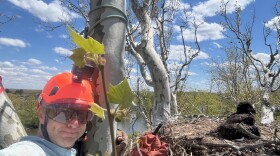 Blood is thicker than water. Scientists are using baby eagle blood to assess the health of Michigan’s environment. Because eagles are top predators, heavily linked to lakes and rivers, they provide a proxy for water quality.
 -
 The federal government announced a new $144 million program to study microplastics and the risks they pose to human health. But some environmental groups say the action isn't aggressive enough.
 -

-
 With the first SMR in North America being built at the Darlington nuclear site, the province is testing new ground to meet future power demand.
 -
 Restarting an aging reactor and building next-generation modular plants on the shores of the world’s largest freshwater system
 -
 This is the first article in our “Shockwave” project, a series of reports that will investigate the rapid evolution of the energy landscape in the Great Lakes region and the consequences the new era will have for one of the world’s largest reserves of fresh water. Produced by the five partners of the Great Lakes News Collaborative — Bridge Michigan, Circle of Blue, Great Lakes Now, Michigan Public and The Narwhal — Shockwave will document the depth and breadth of the region’s energy transformation and its influence on water use and pollution.
 -
 Didymosphenia geminata — didymo for short — also has another, much less scientific, nickname: rock snot. It seems to be spreading in Michigan waterways.
 -
 Democratic State Senator Sam Singh has introduced a bill that would require the establishment of a statewide sanitary code for septic systems. Many similar bills have failed to win support in the state legislature over the decades.


Additional Environmental Coverage


