

With one Arctic front behind us, and another one already taking its place, it’s been cold outside. That means the Great Lakes have also been icing over.
How much of the Great Lakes are frozen over?
As of February 2, data from the National Oceanic and Atmospheric Administration’s Great Lakes Environmental Research Laboratory (GLERL) show ice covering just over half of the Great Lakes surface area: 50.57%. As for ice coverage on the individual lakes:
- Superior - 34.31%
- Michigan - 33.33%
- Huron - 77.49%
- Erie - 95.33
- Ontario - 37.23%
Why do some lakes have more ice coverage than others?
Depth and surface area play a role in how much heat the lakes store, according to GLERL. This is why Lake Ontario, with its relatively shallow depth of 86 meters on average (244 meters at its deepest point) and smaller surface area, generally has the least ice cover.
Can blue ice form on the Great Lakes? How?
While it’s an unusual phenomenon in the lakes, GLERL says blue ice can sometimes develop, but it’s short-lived.
Blue ice is formed when ice gets very thick and doesn’t have air bubbles or other inclusions. This allows longer wavelengths of light to penetrate further through the ice and be absorbed, reflecting shorter wavelengths (like blue). In deep water, where there isn’t much chlorophyll, the reflection of the water can also make the ice look more blue.
When were the ice cover highs for the Great Lakes?
Lakes Superior and Erie froze over completely in 1996, and Lake Erie has also frozen over in 1978 and 1979. Lake Huron reached 98.2% ice cover in 1994. Lake Michigan had 93.1% ice cover in 2014. Lake Ontario had 86.2% ice cover in 1979.
What happens when ice cover gets high?
Ice cover can prevent evaporation from the Great Lakes and inhibit the development of lake effect snow that can otherwise blanket some Michigan communities.
If enough ice forms on the upper reaches of Lake Huron, an international ice bridge connects Drummond Island, off Michigan's Upper Peninsula, to St. Joseph Island in Ontario. This year, the route opened on January 27.
And in cold winters there have been instances of wolves using ice bridges to cross Lake Superior between Michigan's Isle Royale and the Michigan and Canadian mainlands.
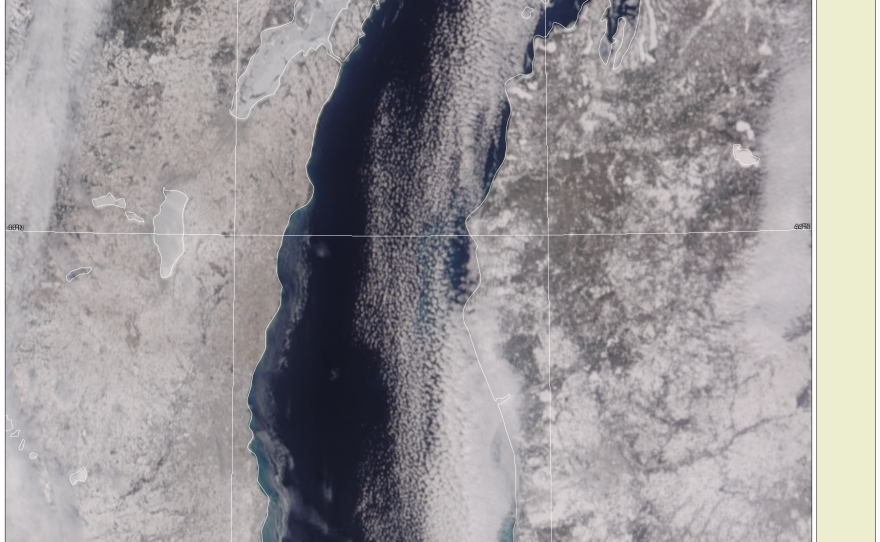
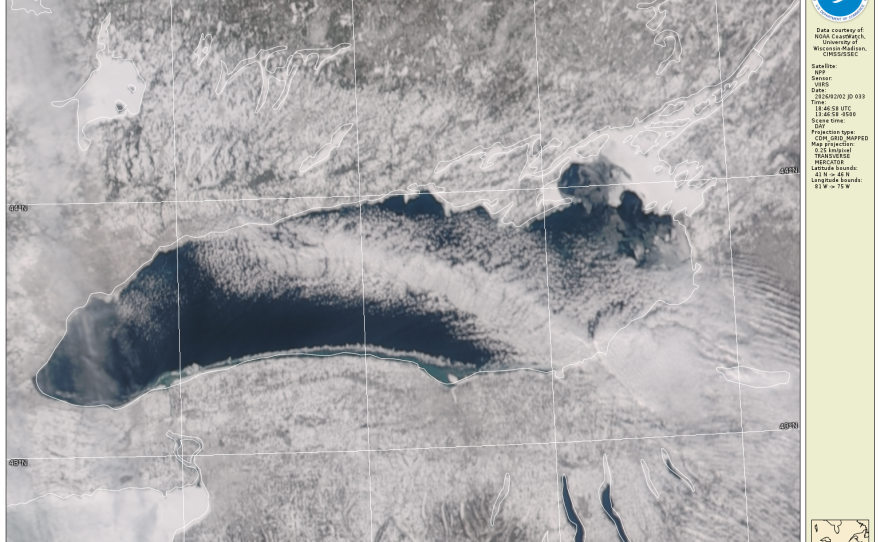
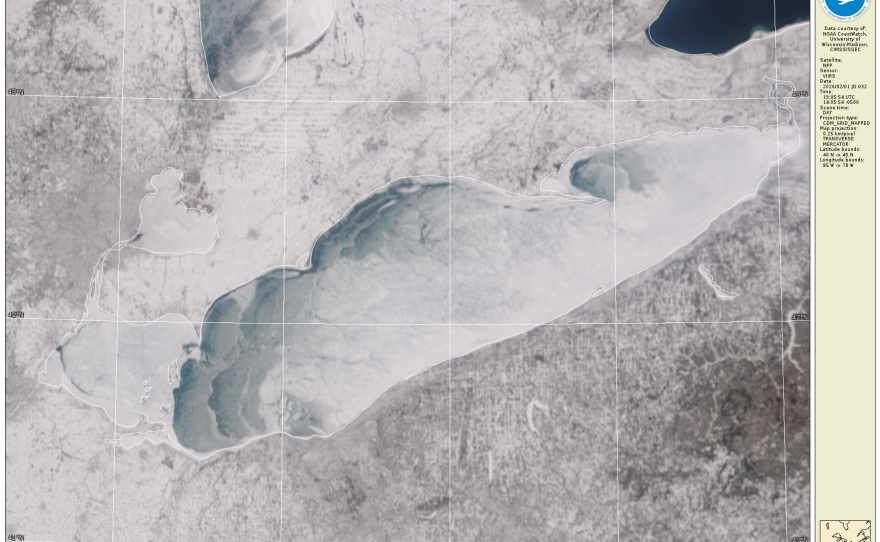
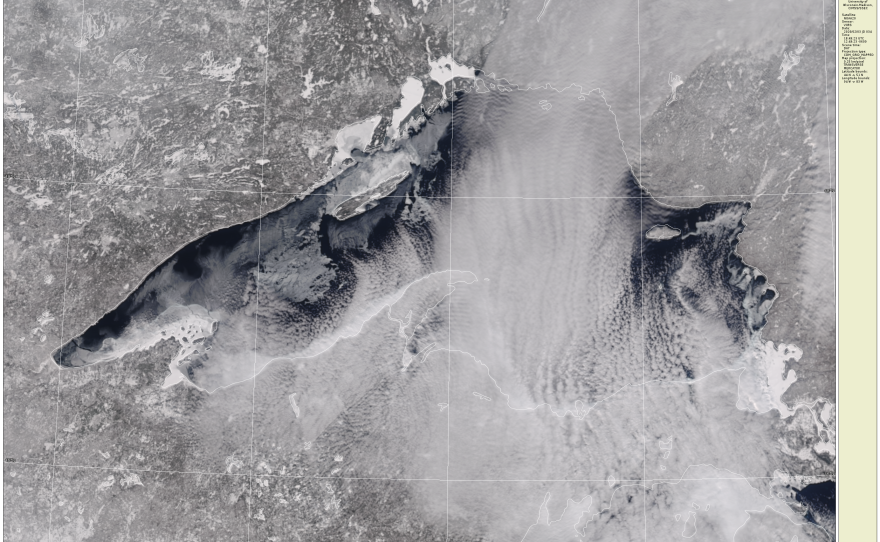
What does ice cover on the lakes look like from space?
Here's a mini slideshow-gallery, starting with Lake Michigan. The lake ice is white. The ice-free lake surfaces are mostly dark blue, where they're not obscured by white clouds. And the surrounding land is a snow-whitened brown.

For more information on ice cover on the Great Lakes, and an interactive map, visit the GLERL website.


