

Experts are trying to understand why the moose population in Michigan remains stagnant.
Researchers with the Michigan Department of Natural Resources, Keweenaw Bay Indian Community, and Northern Michigan University are collaborating on a study of the question.
The state partnered with Canada in the mid-1980s to reintroduce moose to the Upper Peninsula. The goal was to produce a population of 1,000 moose by the year 2000. Data from the DNR shows that annual growth has slowed to less than 1% since 2009.
There are an estimated 300 moose in the state, according to a 2025 DNR biennial aerial survey in Marquette, Baraga and Iron counties. That’s down from the 426 moose found in a 2023 survey.
According to a DNR press release, it’s unclear if lower estimated numbers indicate a overall population decline, a shift in moose in historically surveyed areas, or a combination of both.
Northern Michigan University Professor Diana Lafferty focuses on wildlife ecology and conservation science. “While it is certainly possible that there has been a decline, those numbers are well within the margin of error that we might get from doing count surveys,” Lafferty said.

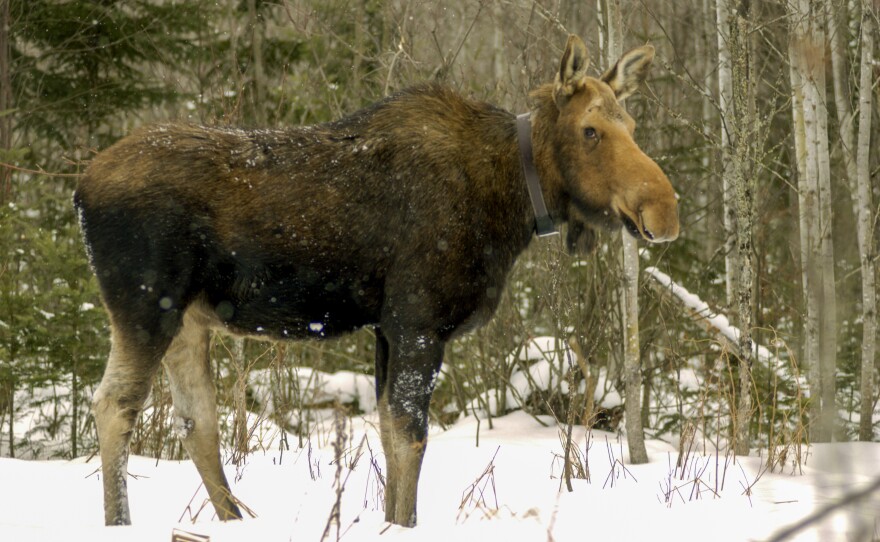
In the first phase of the study, 20 moose were captured, collared, and released. Since then, researchers have been able to use GPS data gathered from the collars to monitor the health of the moose. They’ve learned that 17 out of the 20 moose are still alive.
This month, researchers are planning to put tracking collars on up to 43 moose from the western Upper Peninsula, where they’re most commonly found.
Lafferty said the team is beginning their moose capture the morning of Feb. 14. “This year is an extension of that effort to increase our sample size of GPS collared animals so that we can dig deeper into survival, land use, and cause-specific mortality,” she said.
“Our intent is to investigate and uncover the factors that might be limiting moose population growth across the Upper Peninsula,” Lafferty continued. She said this includes collecting swabs for disease surveillance, searching for ticks, and collecting fecal pellets to better understand diet. The GPS collars will help researchers understand how the moose are using the landscape.
Lafferty said the data is used to track births, because females make distinct movements when they’re walking in labor. “We're able to go out and actually use our drone to stay really high and far away from that animal to confirm birth,” she said.
Lafferty said it’s important to understand if there are moose that migrate out of the core area being monitored. “Getting an idea about how many animals within the population are resident versus migrants is also really important, because the more you move, the more potential there is to come into conflict with, for example, roads,” she said. “And moose and roads don't get along particularly well.”
Car collisions have killed 60 moose in Michigan over the past 4 years, according to statistics compiled by the DNR’s Wildlife Division and the Michigan Department of Transportation.
Wolves and black bears are common predators for moose. Moose are also susceptible to winter ticks, which can result in hair loss, blood loss, and skin irritation. The ticks don’t carry disease, but the loss of a full coat of hair can be fatal in cold winters.


