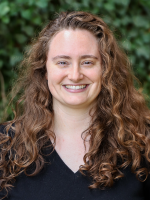
The rate of mood and anxiety disorders in pregnant people in the United States is on the rise. That’s according to research by Kara Zivin, a behavioral health services and policy researcher at the University of Michigan.
Zivin writes about her work and her own severe depression struggle during her pregnancy in a new book Persevered: A Maternal Mental Health Memoir. She joined Michigan Public's Morning Edition producer Caoilinn Goss to talk about it.

Caoilinn Goss: What drew you to study depression?
Kara Zivin: I studied depression because I struggled with my mental health in high school, and I became a peer counselor in high school and in college. And I had thought about trying to become a psychologist myself, prior to deciding to take a population-level approach to studying mental health.
And I think that there's a lot of work that still needs to be done to increase awareness and decrease stigma. Stigma has improved. People are more aware of a range of mental health conditions that people experience, but there's more work to be done.
CG: You know, I'm someone who deals with internalized stigma and external misconceptions around mental health, so I want to thank you for being so transparent in your book. Can you describe what happened to you during your pregnancy?
KZ: It became a swirl of insomnia, depression, anxiety that got worse and worse as my pregnancy progressed, even when I ended up returning to treatment. I had decided to stop taking an antidepressant when I became pregnant. And when people go off their medication, two-thirds of them relapse during pregnancy or postpartum. And I became one of those people.
As my pregnancy progressed and I got worse, I ultimately overdosed on medication during my eighth month of pregnancy and became hospitalized. And I still was not appreciably better when I was discharged and ultimately made the decision to undergo electroconvulsive therapy, which is what helped my mental health improve.
CG: In your book, you talk about the dilemma of whether to stay on antidepressants while pregnant. How has thinking around the impact of taking mental health medications during pregnancy changed — or not changed — in the 15 years or so since you gave birth?
KZ: Each person has their own unique set of risks associated with potentially taking treatments versus risks associated with not taking an antidepressant. There's also more different types of medications. I think people are starting to understand that if a mother's mental health is poor during pregnancy, that can have negative outcomes not just for her but also for her child. And so it really is a risk-benefit calculation for each person.
CG: In 2012, the year after you gave birth, the American Medical Association began advocating for better mental health services for pregnant and postpartum mothers. In 2015, the American College of Obstetricians and Gynecologists recommended doctors screen their patients at least once during pregnancy for mental health conditions. So, best practices are evolving. Why do you think it took so long?
KZ: I imagine that women have struggled with mental health during pregnancy from time immemorial. Our understanding may have changed and how we address it may have evolved over time. I think that there has been greater awareness as well as treatment availability.
I've been pleased to see that multiple different types of professional organizations have started to pay attention to this issue. However, screening just once during pregnancy or postpartum is probably not enough.
"The risk of suicide and mental health conditions is a leading cause of preventable maternal morbidity and mortality."Professor Kara Zivin
CG: Perinatal mental health includes mental health during pregnancy and for the two years after childbirth. In your book, you describe a few prevailing misconceptions about perinatal mental health. What are some of the most persistent and most dangerous ones you've encountered, either personally or in your research?
KZ: I did not realize, and I don't think many people do realize, that the risk of suicide and mental health conditions is a leading cause of preventable maternal morbidity and mortality, which we typically measure as up to a year postpartum, not just in the immediate aftermath of delivery. And when you put it that way, it's a much bigger problem than I think people are aware of.
CG: In your book, you talk about how lower-income mothers and women of color are at an even higher risk for maternal depression than more affluent white populations. Why do you think that is, and what more work is needed to narrow that gap?
KZ: Income, housing insecurity, unstable employment. Lack of consistent health insurance, lack of access to both obstetric care or mental health care, or both. There is both a mental health provider shortage around the country — there just aren't enough mental health providers — and there also are maternity care deserts, where there just aren't obstetricians within a reasonable driving distance.
Part of why I've written and spoken about my personal experience is to indicate that even with every possible advantage that I could have had, I still got very sick. And I recognize that other people may not have the same access to treatment that I did.
CG: How are you doing 15 years out and how is your family doing?
KZ: You know, my son is now in high school and he understands that part of why I talk about the difficult circumstances surrounding my pregnancy is to try to support other women and families.
As far as other aspects of my life, I was not studying maternal mental health prior to my illness. I was actually doing research on older adults and centering my work at the Department of Veterans Affairs. But it was really important to me to pivot. Now, it's hard to disentangle how my life might have been otherwise if this had not happened, because my professional life and my personal life became entwined.
CG: Perinatal depression remains the most under-diagnosed pregnancy complication in America. What advice do you have for anyone out there who might be going through what you went through?
KZ: People ask questions like, what would you tell your younger self about what happened? And I wish I had trusted myself more. In society, we have so many expectations about what parenting is like, what pregnancy is like, and yet we each have to make those decisions and live our own lives and build our own relationships with our children and family. And I wish I had more confidence than about doing that.
CG: Professor Zivin, thanks so much.
KZ: Thank you. Thank you for supporting mental health.
If you or someone you know is struggling or in crisis, help is available. You can call or text 988.
Editor's note: Some quotes in this article have been lightly edited for length and clarity. You can play the audio of the full interview near the top of this page.