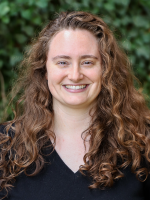
February is Black History Month, and on Morning Edition we are sharing stories of Black women who were pioneers in Michigan politics.
In 2013, Senita Lenear became the first African-American woman elected to the Grand Rapids City Commission. She served for nine years before reaching a term limit. She spoke with Michigan Public Morning Edition producer Caoilinn Goss.
Caoilinn Goss: You represented the city’s Third Ward, and you also grew up there. What was that like?
Senita Lenear: So I moved to Grand Rapids when I was nine years old. I'm a proud Creston Polar Bear, and anyone who knows me knows that I graduated from Creston High School. I even stayed in the city and graduated from Cornerstone University.

CG: You’re a business owner. You’ve served on nonprofit boards. You’ve sat at union bargaining tables and worked in the corporate sector. How did those experiences lead you to run for city commissioner?
SL: I worked for the largest medical insurance provider in the state of Michigan for over 14 years and had various experiences there — and you've named some of those — one of which was a regional role for community affairs. And it was through that work, I believe, in community affairs that I really had kind of this bug to want to serve, but not necessarily in public office.
It really wasn't until there was a seat that was vacated on the Grand Rapids school board and my sister called me because they were talking about it on the news. And she said, "Well, you should do this." And I was like, "Well, why?" And she goes, "Well, you're coming to our kids' conferences with us."
I would go to my nephews and niece's conferences with their parents, and I would be the one asking questions. And so it was through that that kind of led me into serving in public office. And so after serving at the school board, I then sought the seat and was elected and served nine years as a city commissioner.
CG: The Third Ward historically saw a lot of unequal investment compared to the rest of Grand Rapids. And while in office, you created the Third Ward Equity Fund and led an effort to grow the Southtown business development district. Why do you think many of these inequities were not tackled sooner?
SL: You're absolutely right. There were these inequities, and it was through this Forbes article that talked about Grand Rapids being the second worst place to live in the country for Black people, economically. And the Third Ward is a predominantly Black population. And the data from the city also said we have underinvested in the Third Ward.
So all of that was brewing, and we were doing a strategic planning meeting about where we were going to prioritize our resources. And my colleague at the time — his name is David Allen — he and I protested because when we looked at all of the options that the staff had presented to us, none of them were in the Third Ward. And it really opened up a conversation about how do we right some of these wrongs and how do we change the practices that we have in order to make better outcomes?
And that's when the Third Ward Equity Fund was introduced. It was from that conversation. It was through the Third Ward Equity Fund funding that started this major renovation to one of our major parks, [the] MLK [Park] Lodge. And so I'm really proud of that.
"When I'm driving through the city and I'm seeing the things that are happening, it makes me proud because I know that my fingerprints are a part of that."Former Grand Rapids City Commissioner Senita Lenear
CG: While you were on the city commission, you also served on several task forces and committees, such as the Great Housing Strategies Committee. You were chairwoman of the Mayor’s Safe Alliance for Everyone Task Force, which focuses on funding efforts to reduce violence in the community. What are some of your proudest accomplishments while in office?
SL: The Southtown Corridor Improvement Authority. It started off as a single business district that I knew after the first meeting could not survive. It was not capturing any funding. We worked really hard to expand that across six business districts.
Right now, we're capturing about half a million dollars annually to be able to pour back into various business districts right on the south side of Grand Rapids. So when I'm driving through the city and I'm seeing the things that are happening, it makes me proud because I know that my fingerprints are a part of that.
CG: You ran for mayor in 2024 and lost to current Mayor David LaGrand. Do you think you’ll run again?
SL: Wow, Caoilinn, that's a really good question. I have not made that decision. When I ran for mayor I knew there were a lot of people who had interest in me running. I knew that I had more to give. And as you mentioned earlier, I was term-limited from serving as a commissioner. You know, it's too early to make a decision about whether I think I would run again. There are so many other ways for me to be passionate in this community that it doesn't have to fit squarely into an elected office.
CG: Since you took office, more Black women have also been elected to the city commission: Kelsey Perdue, Lisa Knight. Looking back, why do you think it took so long to break through?
SL: That was another thing that I did not take lightly. Making sure that the work that I did, you know, was work that others could see themselves doing. And not to say that either of the two women that you named you know, sought after the position because I was in it, but it did make me feel good that I was leaving the role with having shattered a glass ceiling but not covering it back up with plywood because that frequently happens.
I would be remiss if I didn't also mention the first Latina that that serves on the city commission, Milinda Ysasi. And that also made me proud to be able to support her candidacy on the commission.
The other thing that I will add, too, is, is that elected office isn't always the answer. And so there are many ways for people to make a difference. Sometimes you're inside of a system, and sometimes you're outside of a system. And you have to know who you are and how you want to serve in order to make a difference.