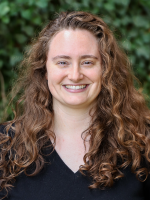
In November, Michigan voters will choose two justices to serve on the state Supreme Court. Michigan Public's Morning Edition is featuring interviews with the six candidates.
In May of 2025, Justice Noah Hood was appointed to fill a vacancy on the Michigan Supreme Court. That partial term will end at the end of this year and he’s now running for a full eight-year term on the court.
Hood spoke with Michigan Public's Morning Edition host Doug Tribou.
Doug Tribou: I want to note here that Supreme Court candidates appear on the ballot without any party affiliation listed. However, the candidates for the court are nominated by political parties. Justices who have Democratic Party support currently hold a 6 to 1 majority on the court. And you have been nominated in this election by the Democratic Party.
You came to the Supreme Court after serving on the Michigan Court of Appeals. Before that you were a judge on the Third Judicial Circuit Court of Michigan in the Criminal Division in Wayne County. Would you explain your judicial philosophy and your approach to the cases that come before you?
Noah Hood: Absolutely. And it's a question that I've gotten now in this capacity that I wasn't used to getting before. And it's taken me a while to come up with a good answer because I'm not super ideological. I wouldn't call myself a textualist, though most of my work sticks to the text pretty evenly. I wouldn't call myself an originalist, though I do look to discern the intent of the legislature when passing bills or enacting a constitutional change. What I would say is, if pressed on my ideology, I would say I'm fact-based, a strict adherence to the facts.
DT: Is there a case or two from some of your years on the bench that has stuck with you as an example of something that you feel reflects the kind of approach you want to bring to the Supreme Court?
NH: Yeah. There's a case that I had a few years ago when I was on the Court of Appeals. C.B. vs. Livingston County Community Mental Health. And that case involved a kid who was a quadriplegic, couldn't speak, couldn't feed himself, couldn't walk. And he was entitled to a certain number of nursing care hours under Medicaid, a certain number of respite care hours under Medicaid. And he wasn't getting them. So his mom sued on his behalf. And we decided that case based on the facts, based on the law, based on principles of fairness, but having no clue at that point in time how it would ultimately impact my own life, having no clue that at some point in the future, I would have my own kid on a trache in a vent, having my own challenges with at-home nursing. I shared that to say you need people doing this work that can make the right call when nobody is watching them, and the right call when everybody is watching them.
DT: Before becoming a judge, you served as an assistant United States Attorney in the Eastern District of Michigan and in the Northern District of Ohio. You did a lot of work on fraud and white collar crime cases. How did that work shape your view of our legal system? I realize that's federal and you're now serving in our state court system. But more broadly...
NH: My work as a federal prosecutor is where I got my trial experience. That work made me a better trial judge. You know, I'll share some of the best advice I've gotten in my professional career was as a new AUSA. Deputy Attorney General James Cole said, when you deal with people, it will be on the worst day of their lives. So you need to do the work right. You need to treat everyone with dignity and respect.
DT: As I mentioned, the justices who have support from the Democratic Party, either as appointees or nominees over the years, have a 6 to 1 majority on the court. What would you say to someone who says, I'm just concerned about imbalance in whatever direction it is?
NH: I would encourage them to read the opinions. That 6 to 1 ostensible majority is a lot more nuanced than that. By way of example, the Eli Lilly case that you all have covered, that was a 4 to 3 opinion. It's a split opinion and doesn't break evenly down partisan lines. And a lot of our opinions have been unanimous this past term, where you have that single Republican-nominated justice joining. Because of that, you'll find that many of our opinions are more measured because we're trying to maintain the public's confidence that we're actually doing legal work. We're not partisan shills. We are looking at the facts first and applying the law.
DT: And I'll note here that the case you're referring to is known as Attorney General vs. Eli Lilly and Company. It involved investigations into insulin pricing practices. Is there any concern and I've asked a few justices this over the past ten years, when there is a high number of unanimous decisions, is there any concern of a perception that the court is taking cases that are less controversial, that they are looking for cases that are easier to decide because it's a clearer line to that kind of ruling?
NH: The short answer is no, because we don't have that time. We don't have the luxury of that capacity to do work on a pitty pat case. We review between 1700 and 2000 applications for leave to appeal every year, but we only hear about 100 cases, and we only write on about 50 of them. The cases that we're taking are those that are jurisprudentially significant. Now, the longer answer is are we selective about which is the case that's the right vehicle for an issue that has been bubbling up? And I would say, yeah, we are. And that's not strictly to get to a specific result, but to make sure that the case has the best vehicle to get our questions answered. You might have someone who has a really good case and they're pro se, they're representing themselves. And then there's a question of, well, will this issue get fairly sorted out with a layperson unrepresented, or do we need a case that's similar that has lawyers on both sides? That's one of the considerations that will go into what is the best way to get to the core issue at the heart of the case?
DT: So you're talking about like, for example, you might have ten cases related to data centers and local versus state control or whatever — we're not talking about actual cases here — but then finding the one that might be have the broadest implications if the court is to weigh in?
NH: That's right. And in some cases, we're obviously going to take the case. We're obviously going to have an argument because it is a matter of public concern and jurisprudential significance.
DT: The state Supreme Court exerts a lot of administrative control over how the court system works as a whole: how lower courts function, rulemaking, that sort of thing. And I wonder, with your experience as a judge in lower courts in the system and now as a justice on the Supreme Court, what areas you're interested in working on, on the administrative side? Do you have particular areas of interest that you'd like to see the court work on and improve?
NH: Yeah, we have to continue our commitment to our specialty courts. These are non-adversarial courts that are focused on treating underlying causes for criminal conduct, whether that's addiction, substance use, PTSD. The most obvious example is the veteran's treatment court. You know, I presided over the Veterans Treatment Court in Wayne County along with Justice Bernstein. I'm one of the two justice liaisons to our treatment courts. Now these programs are working. They're quite literally saving people's lives. And if that's not a good enough reason, they're also saving money in our system because they are lean run programs. People get to keep their job. They're not resulting in new arrests. They are across the board working. And if they continue to work at some point in the future, we're going to have to have a conversation about expanding them.
DT: Well, Justice Hood, thank you very much for your time.
NH: Thank you.
Editor's note: Quotes in this article have been edited for length and clarity. You can play the full audio of this interview near the top of this page.