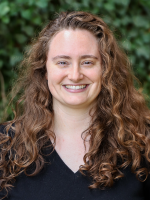
In November, Michigan voters will choose two justices to serve on the state Supreme Court. Michigan Public's Morning Edition is featuring interviews with the six candidates.
Judge Casandra Morse-Bills is currently the presiding judge in Michigan's 23rd Judicial Court, which covers Alcona, Arenac, Iosco and Oscoda counties. She's been elected twice and has served on the court since 2018.
Morse-Bills spoke with Michigan Public's Morning Edition host Doug Tribou.
Doug Tribou: Judicial candidates in Michigan are listed without any party affiliation on the ballot. However, parties do nominate candidates for the court, and the Michigan Republican Party selected you as one of its nominees. The Democratic nominees currently hold a six to one majority on the court. As I mentioned, you are a judge for the 23rd Judicial Court in Northern Michigan. Could you describe the role that court plays in our state court system and the most common types of cases that you hear there?
Morse-Bills: Well, I'm part of the largest geographical circuit in the state of Michigan. And you're correct, it's four different counties. However, I'm very uniquely situated even within my circuit. We have a small population, like many counties in Michigan, but we're very rural. And so I'm the only judge in my county, which means that I am elected as the probate judge, but I preside over probate district and circuit court. I'm also the circuit court judge for criminal and civil matters in Arenac County as well. And I do all of the appeals for circuit court for our four-county circuit. So I do literally everything that you could possibly see in the courtroom, from arraignments and criminal court to civil litigation all the way to malpractice and, you know, homicide trials. I do everything in between.
DT: Could I ask you to describe your legal philosophy and the approach you take to cases that come before the court?
CMB: So my judicial philosophy is very simple. It is that I am a rule of law judge and that I follow the law and the Constitution. And for some reason, some individuals who hold judicial positions have lost sight of that and are not practicing our oath of office. Oftentimes in my courtroom, I'm bound by the law and required to make decisions that I don't necessarily personally agree with. However, I'm following the law. There's no room for politics in a courtroom. That belongs with our legislative branch. It does not belong on our Supreme Court.
DT: Could you tell us about a case or two that you've heard? And I know you've heard many, and many different kinds, that stand out in your memory as an example of the kind of work or mindset that you would bring to the Supreme Court.
CMB: Before I was a judge, I was the elected prosecuting attorney, and I was a defense attorney at one time as well. But I have been involved in many cases that impact victims. And I feel like that is something that really needs to be highlighted in this year's election. When you are starting to actually deal with humans and deal with people and what's happening to them, it's very different than somebody making a decision, an administrative decision or a technical decision regarding the law from the Supreme Court. The cases that stick out to me the most are the ones where I've been able to help people, and I've been able to help victims of crimes. And I could go on and I could talk about specific cases. However, I'm going to choose not to. I think for this interview, because some are very horrendous, some are very sad, but understand that these are the things that judges and attorneys deal with on a daily basis.
DT: Earlier this year, a former Oscoda County clerk filed a federal whistleblower lawsuit that claims she was fired for revealing that you exchanged text messages with a juror in a case last year. This was during a sexual assault case that you presided over. What is your reaction to that lawsuit and where does it stand today?
CMB: Well, that lawsuit is actually pending, and it has come up because I'm running for Supreme Court. So it was a district court clerk who filed this lawsuit because she was discharged. And she did make the allegation that I had been communicating with a juror in a trial. It's 100% incorrect and false. Frankly, what happened is I live, as I said, in a very small community. So you can imagine, I literally leave work and I'm at the grocery store and I see people that I sentenced that day or that I decided their custody case that day or what have you. And that was what was reported is that I had talked to an individual who was an alternate juror on that trial, in fact, after trial. So there was never anything done during trial. And I can say with 100% confidence that it will be dismissed. It's very convenient that this case came about after the information came out that I was running for Supreme Court. So, you know, I hope that that fully explains the situation to the extent that I can discuss it at this point. Again, because that case is pending.
DT: The state Supreme Court justices work on a lot of rules and guidelines for lower courts in Michigan. And you've been a judge in the Michigan court system for several years now. Is there an issue or problem within the system that you've seen, in your view, from one of the lower courts that you would like to try to change if you're elected to the Supreme Court?
CMB: Five out of our seven Supreme Court justices that we currently have never served as a judge before they were elected to the Supreme Court. You know, as I said in the beginning of this interview, and I 100% hold true to this, that there is no place for politics in the court. However, this Supreme Court is so unbalanced. They have a supermajority, and it has been showing through their opinions that have been issued repeatedly over the years. There are many, many changes that I would make. However, one that we are working on currently on the Michigan Judicial Council that I think is very important ... with advancing technology, and that's providing equal access to our courts. So I know it's very difficult for people who represent themselves to navigate the court system, and I see that firsthand every day, because I have many individuals in my county that are impoverished and they can't afford an attorney, but yet they still have to navigate the court system. So I would like to see huge improvements in accessibility for everybody who needs to come into the court, but also consistency. So I'm a big believer in that our court system should not differ so drastically from one county to the next. So, I mean, I have adjacent counties to my own where they handle different procedures very differently and filing requirements. We're a statewide court system, and so we should have some more uniform procedures that are put into place. So those are just two of the changes that I would try to initiate immediately if I was elected to the Supreme Court. But there are many more.
DT: Just to follow up on the makeup of the court, with the exception of Justice Noah Hood, who was appointed to his seat on the court but has been a judge at two other levels beforehand, all of the judges — or the justices, I should say — on the court, are currently elected officials. Would you change the requirements, then, for electing the Supreme Court, because the voters of Michigan chose to put in people who did or did not have justice experience prior to being in their role now?
CMB: So would I try to change the requirements to be elected? No, I wouldn't do that. But what I would want to do is try to better inform the general public of the importance of the Supreme Court, the current makeup of the Supreme Court, and the issues that it is causing, not only in our court system but also in our communities.
DT: Judge Morse-Bills, thank you very much for your time this morning.
CMB: I thank you very, very much for having me and for allowing me this opportunity.
Editor's note: Quotes in this article have been edited for length and clarity. You can play the full audio of this interview near the top of this page.