

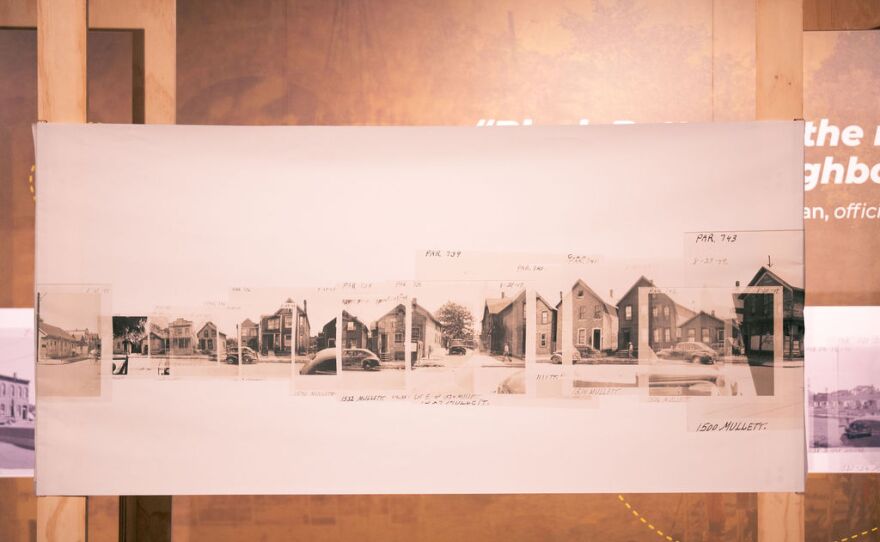


Black Bottom and Paradise Valley were vibrant, community-driven neighborhoods in Detroit home to many Black-owned businesses — until they were demolished for redevelopment and the construction of a new freeway.
It’s difficult to know how many people were displaced from these neighborhoods in the 1950s and ’60s. One estimate based on archives suggests nearly 4,000 families were forced out by urban renewal projects in both neighborhoods. Today, what could possibly repair these past transgressions?
For the past two years, archivists from the Black Bottom Archives (BBA) have been trying to answer that question by collecting oral histories from former residents. This work is part of the Sankofa Community Research Project.
An exhibit at the Detroit Historical Museum, “From the Bottom Up,” showcases what those who called those neighborhoods home see as a start towards reparations. The exhibit will run through April 5.
Black Bottom displacement began after the Housing Act of 1949 provided funds for urban renewal in Detroit. Development of Lafayette Park, which was a majority-white neighborhood, drove out many Black Bottom residents who could no longer afford their community. In 1959 construction began on the I-375 portion of the Chrysler Freeway, according to city officials, “effectively killing Hastings Street, the business thoroughfare that bridges Black Bottom and Paradise Valley.”
But before the neighborhood was destroyed, Black Bottom was where Detroiter Rosie Chapman called home.
“In Black Bottom, everybody knew everybody in the neighborhood, on the street,” Chapman told Black Bottom Archives. “We did not lock our doors. I never had a key. We went to school, came home, opened the door and went in. Everybody was on the same level.”
Chapman is one of fifty former Black Bottom residents who participated in an oral history project led by BBA Co-Directors Lex Draper Garcia Bey and Marcia Black. Guided by the West African Adinkra principle of Sankofa, which means “go back and get it”, Black and the team worked to collect first hand accounts of what was lost when these neighborhoods were destroyed.
“‘Go back and get it’ as a concept is important because what we're going back and getting are our stories, wisdom of past generations, lessons that are important to make sure that we're not replicating our past,” Black said.
“From the Bottom Up” features an extension of Black Bottom Street View — a panoramic wall with a timeline of Black housing in Detroit, including panoramas of reconstructed Black Bottom streets from archival photographs.
There are many ways to access BBA's audio and digital work, such as QR codes to the archives’ immersive digital map of Black Bottom, an educational zine, and an immersive mix by DJ MilkyWay, who infused oral histories with music to create a soundscape.
The exhibit closes April 5, but the work of Black Bottom Archives extends beyond the Detroit Historical Museum. The team has conducted teach-ins, panels, and community engagement sessions, acting as a representative for Black Bottom residents while in communication with the state’s I-375 project team.
An event at the Detroit Historical Museum April 4 will celebrate the closing of the exhibit, featuring a panel of Black Bottom community members and a hands-on lab teaching attendees how to digitize their family photos and memorabilia.
“Why we remember Black Bottom and Paradise Valley is not because of any sort of city investment in remembering these neighborhoods,” Black said. “A lot of why we remember today is because of the community choosing to continue to tell their stories, to find ways to keep community, even though it didn't exist in the physical form.”


